
When the cluster fails,we repair it.
Specialist instrument cluster repair across European, Japanese and Korean vehicles. LCD pixel restoration, dead gauges, backlight faults, stepper motor failures, dry joints and full rebuilds — all carried out in-house, with original mileage and vehicle coding preserved.
Repair feasibility depends on the specific fault, part availability, vehicle model and diagnostic outcome. Every cluster is assessed before a quote is issued.
Recognise any of these?
If your cluster shows any of the following symptoms, the underlying cause is almost certainly fixable. Bring the vehicle in for assessment.
Blank dashboard
Cluster fails to illuminate or initialise — needles fall, displays stay dark.
Faded or missing pixels
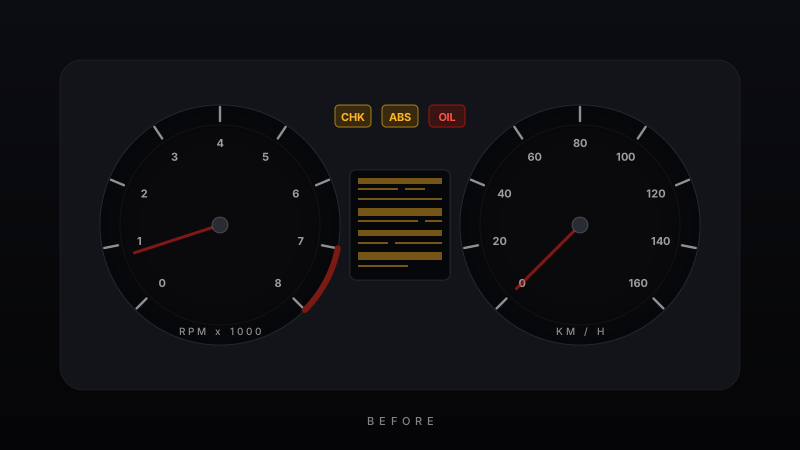
Centre LCD shows horizontal gaps, missing rows or characters that are no longer legible.
Dim or failed backlight
Cluster becomes unreadable at night — typically a backlight LED or driver failure.
Gauges not moving
Speedometer, tachometer, fuel or temperature gauges read incorrectly or stop entirely.
Intermittent display
Cluster flickers, resets while driving or works correctly only when warm or cold.
Warning lights stuck on
False or persistent warning illumination that does not clear after a known good repair.
No cluster communication
Cluster appears electrically alive but does not communicate with the vehicle’s diagnostic network.
Incorrect mileage display
Stored mileage is corrupted or mis-read after another module replacement upstream.
Cluster power failure
Cluster does not power up at all — usually a supply, ground or internal regulator fault.
Eight steps, from intake to handover.
Every cluster passes through the same workflow. The output is a documented, tested unit that goes back into the vehicle once — not twice.
- Step 01
Initial fault assessment
You describe the fault. We capture the symptoms and confirm whether bench or vehicle-side testing is required.
- Step 02
Vehicle or bench diagnostic
Live data, voltage and CAN-bus traffic captured. The fault is isolated to module, supply or wiring before any cluster is opened.
- Step 03
Cluster removal
Where required, the cluster is removed using OEM procedures with airbag and battery safety steps observed.
- Step 04
Internal inspection
Cluster opened in a controlled environment. PCB inspection under magnification for dry joints, failed components, ribbon damage and corrosion.
- Step 05
Component-level repair
LCD ribbon restoration, stepper motor replacement, backlight LED replacement, dry-joint repair and driver-IC replacement as required.
- Step 06
Reassembly
Cluster reassembled with new gaskets where applicable, cleaned and verified for cosmetic finish before bench power-up.
- Step 07
Testing & verification
Bench-tested across the full gauge sweep and warning matrix. Where required, refitted to vehicle and verified on the road.
- Step 08
Customer handover
You receive a written summary of the fault, the repair carried out, and any follow-up recommendations.
Repair before replace, every time.
A replacement cluster is rarely the right answer. Here's why a proper repair almost always wins.
Keep your mileage
A repaired cluster keeps your original vehicle mileage intact. A second-hand replacement rarely does.
Keep your vehicle pairing
Your cluster is coded to your vehicle. Repair avoids the programming complications of a swapped unit.
Lower total cost
Component-level repair is almost always more cost-effective than sourcing an OEM replacement.
Faster turnaround
Local in-house repair means days, not weeks of shipping and supplier wait time.
What we cover
- Dashboard cluster diagnostics
- LCD pixel repair
- Dead display repair
- Backlight repair
- Faulty gauge repair
- Speedometer faults
- Rev counter faults
- Fuel gauge faults
- Temperature gauge faults
- Warning light faults
- Intermittent power issues
- Cluster communication faults
- Circuit board inspection
- Dry joint and solder repair
- Stepper motor faults
- Complete cluster rebuilds
- Instrument cluster restoration
- Coding & reprogramming where applicable
- Vehicle-specific testing where available
Restoration, not replacement.
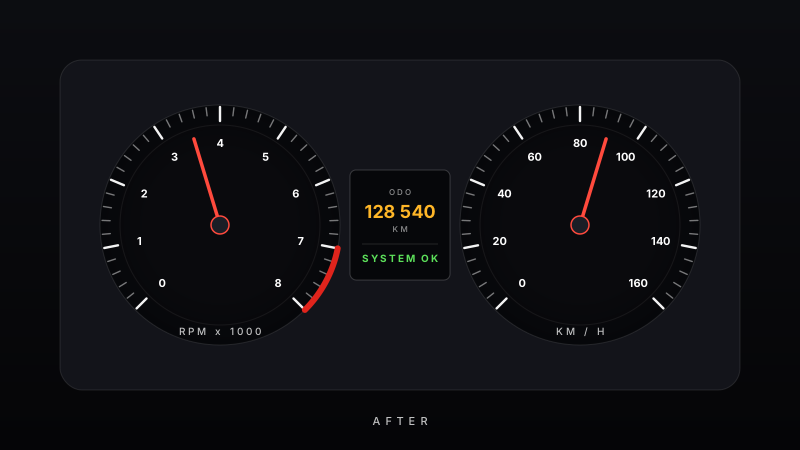
Drag the slider to compare a typical LCD pixel failure with the same cluster after restoration.
Common questions
In most cases yes — LCD pixel failure, dead gauges, backlight issues and intermittent faults are typically component-level repairs. Repair feasibility is confirmed after diagnostic assessment.
Ready when your vehicle is.
Whether it's a Stage 1 remap, a stubborn DPF, an ECU refusing to wake up or a faded instrument cluster — drop us a line and we'll tell you exactly what's involved.